Skip to content
Introduction
If you run a cutting line for footwear, luggage, automotive interiors, or furniture, you have probably heard the term “oscillating knife cutter” but never seen the mechanism explained without jargon. Purchasing managers and production teams make better buying decisions when they understand what is actually happening on the table — and why this method beats die-cutting and laser for many flexible materials.
This guide walks through the working principle in plain language: the vibrating blade, the servo that drives it, the vacuum bed that holds your material, the software that turns a design file into a cut path, and the vision systems on newer models. It pairs with our complete guide to oscillating knife cutting machines if you want the full buying picture.
The Core Idea: A Vibrating Blade, Not a Laser
The simplest way to picture it: a small knife is mounted in a head and moved up and down very fast — “oscillating” — while the head travels along the shape you want to cut. The blade acts like a tiny reciprocating saw, slicing through the material with mechanical force rather than burning or melting it. Because there is no heat, you get sealed, fray-free edges on fabric and no toxic fumes on synthetics.
That single difference — cold mechanical cutting instead of thermal cutting — is why factories choose an oscillating knife cutter for leather, foam, and technical textiles where edge quality matters.
Main Components and What They Do
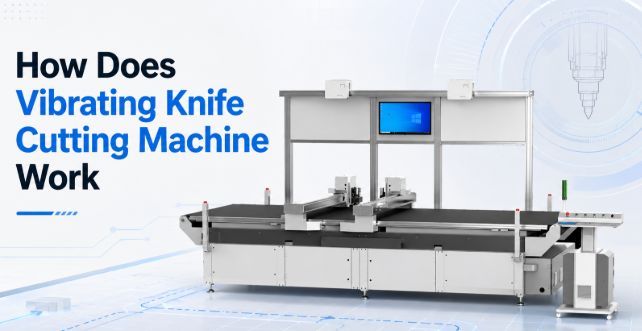
| Component | What it does |
|---|---|
| Servo motor & oscillator | Drives the blade up and down thousands of times per minute at the set oscillation frequency |
| Tool head / blade holder | Holds the blade; swap blades for leather, foam, fabric, rubber and cardboard |
| Vacuum table | Sucks the material flat against the bed so it cannot lift or shift during the cut |
| Nesting / control software | Imports DXF / PLT, auto-nests parts to save material, sends cut paths to the head |
| Vision camera (some models) | Scans the material, finds the outline, matches the pattern — e.g. the ELS-B13S with a 20-megapixel camera |
| Linear guides & belt drive | Move the head accurately along X / Y for stable ±0.1mm repeatability |
How the Blade Actually Oscillates
The heartbeat of the machine is the servo motor. It converts electrical pulses into a fast, controlled up-and-down motion of the blade. The operator (or the software) sets the oscillation frequency and the feed speed for the material:
- Denser materials (leather, rubber) need a higher frequency and steadier feed
- Light fabrics need a sharper blade and a gentler speed to avoid dragging
- Foam and EVA need the right blade angle so the cut stays clean, not torn
Because the blade is a consumable, the cut quality is only as good as the last blade change — which is why our ELS-3016S leather cutting machine holds ±0.1mm accuracy when serviced on schedule.
The Vacuum Bed, Nesting Software and Camera
Three systems turn a flat sheet into finished parts:
1. Vacuum table — a perforated bed with a pump pulls air through the material, pinning it flat. No clamps, no taping, no shifting mid-cut.
2. Nesting software — you import a DXF or PLT file; the software arranges (nests) the parts to waste the least material, then converts the shapes into head movements. On leather, defect-aware nesting skips scars and loose grain.
3. Vision camera — on visual-positioning models, a high-resolution camera reads the real outline of the hide or fabric, then aligns the pattern to it automatically. The ELS-B13S uses a 20-megapixel camera for this, so oddly shaped off-cuts still cut accurately.
From File to Finished Part: The 6 Steps
Here is the full cycle, start to finish. The printable checklist below doubles as a training aid for new operators.
| ☐ | 1. Load the file — import your DXF / PLT design into the nesting software |
| ☐ | 2. Nest the parts — software auto-arranges pieces to save material (5–10% more yield on leather) |
| ☐ | 3. Lay the sheet — place material on the vacuum bed; suction holds it flat |
| ☐ | 4. Scan (vision models) — camera reads the outline and aligns the pattern |
| ☐ | 5. Cut — servo oscillates the blade as the head travels the path to ±0.1mm |
| ☐ | 6. Collect — finished parts drop to the collection area; the next sheet feeds automatically |
Want to see it cut your own material?
Send us a sample of leather, foam, or fabric. Hanhai engineers will run free test cuts on our oscillating knife cutters and return a no-obligation report and quote within 48 hours.
FAQs
How does an oscillating knife cutting machine work?
A servo motor vibrates a mounted blade up and down thousands of times per minute while the head travels along a path from your DXF or PLT file. A vacuum table holds the material flat, and linear guides move the head to about ±0.1mm. The blade slices mechanically — no heat — so edges stay clean on leather, foam, and fabric.
What makes the blade move up and down?
A servo motor drives the oscillation. The operator or software sets the oscillation frequency and feed speed for the material: higher frequency for dense leather or rubber, gentler speed for light fabric. The motor is the reason cut quality stays consistent part after part.
What materials can an oscillating knife cutting machine cut?
It handles flexible and semi-rigid sheets: leather (natural and synthetic), foam, EVA, fabric, rubber, gasket material, cardboard, and many composites. The right blade and frequency are matched to each material, which is why blade choice matters more than machine size.
How does the vacuum table hold the material in place?
A perforated bed connects to a vacuum pump that pulls air through the material, pinning it flat against the surface. This removes clamps and tape, stops the sheet lifting during a cut, and is why thick foam or layered rubber still cut cleanly. Weak suction is the most common cause of slipping.
How does the machine read my DXF or PLT file?
You import the DXF or PLT design into the nesting software, which arranges the parts to waste the least material and converts the shapes into head movements. Most controllers also accept AI, EPS, PDF, and common image files. Flatten layers and remove construction lines if a file will not import.
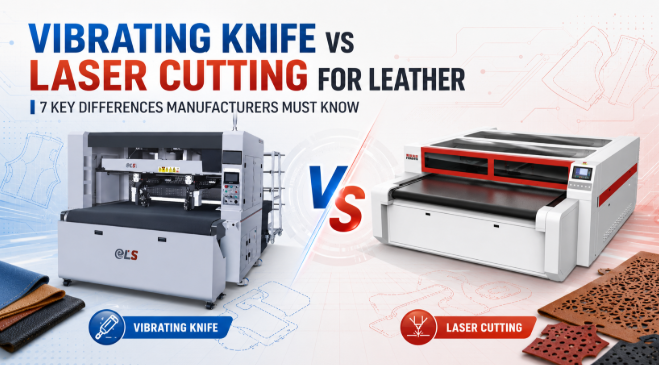
What is the difference between oscillating knife and laser cutting?
An oscillating knife cuts mechanically with a vibrating blade; a laser cuts with a focused beam. The knife gives cold, sealed, fray-free edges with no fumes — ideal for fabric and synthetics. Laser is faster on some thin materials but can melt edges and release fumes. For leather and technical textiles, the knife usually wins on finish.
How accurate is an oscillating knife cutting machine?
A serviced machine holds about ±0.1mm cutting accuracy, with repeat positioning driven by linear guides and belt drives. Accuracy depends on a sharp blade, tensioned belts, and a clean calibration — all covered in a basic maintenance routine.
Is an oscillating knife cutting machine safe to use?
Yes. There is no laser beam or cutting heat, and Hanhai models carry CE-certified components with emergency-stop and sensor protection. The blade is enclosed in the head, and safety sensors pause the head if a guard opens. Standard workshop training and the pre-run checklist keep operation safe.
How fast can an oscillating knife cutter cut?
Speed depends on material, blade, and thickness. The ELS-3016S reaches up to 1200mm/s maximum cutting speed on suitable materials; sample and camera models run in the 72m/min class for high-precision work. Throughput also comes from auto-nesting and automatic sheet feeding, not just head speed.
Can one machine cut, punch and mark in one pass?
Yes. Hanhai cutters use double heads that can asynchronously cut, punch, and scribe in one continuous run — the ELS-B2S sample cutter adds a double-head punch with four punch heads. This combines processes that once needed separate die-cutting and marking stations, saving floor space and labor.
Conclusion
An oscillating knife cutting machine works by vibrating a blade with a servo, holding the sheet on a vacuum bed, and following a DXF / PLT path to about ±0.1mm — a cold, clean cut with no laser heat. Add nesting software and an optional vision camera, and you get consistent parts from leather, foam, and fabric with less waste and fewer skilled workers.
To see the principle in action on your own materials, contact our engineering team for free test cuts and a no-obligation quote.
Related Resources
- The Complete Guide to Oscillating Knife Cutting Machines — full buying picture
- Vibrating Knife Cutting Machine (product category) — full Hanhai range
- CNC Leather Cutting Machine (product category) — leather-specific models
Recommended Products
- ELS-3016S Vibrating Knife Genuine Leather Cutting Machine — ±0.1mm accuracy, up to 1200mm/s, leather defect identification
- ELS-B13S Channel Type Intelligent Cutting Machine — 20-megapixel camera visual positioning, reads DXF/PLT/AI
- ELS-B2S Intelligent Sample Cutting Machine — double-head punch (4 punch heads), ideal for prototypes
- ELS-B6616S CNC Flexible Leather Material Cutting Machine — fully automatic nesting, lifts leather yield 5–10%