Skip to content
Introduction
If you run a production line that touches leather, fabric, foam or any flexible sheet, you have probably asked one practical question: where exactly does a vibrating knife cutting machine fit, and is it worth replacing manual die-cutting or a laser? The short answer is that this machine earns its place anywhere you need clean, sealed-free edges on soft materials at volume—without the smoke, heat distortion or fixed tooling cost that comes with other methods.
This guide walks through eight real-world applications, the materials each one handles, and the production gains factories typically report—so purchasing managers and production teams can map the right configuration to their own shop floor before requesting a quote.
How a Vibrating Knife Cutting Machine Works
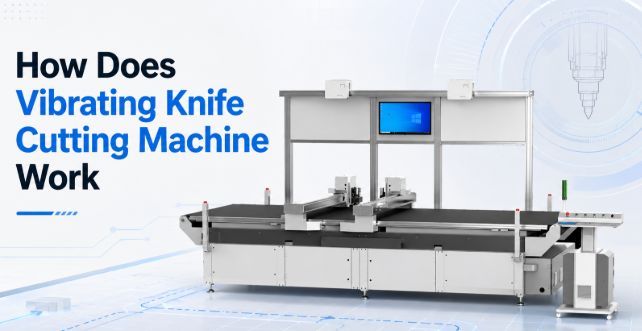
Unlike a laser that vaporizes material with heat, a vibrating knife uses a small blade that oscillates thousands of times per minute (driven by a servo motor) to physically slice through the sheet. A vacuum table holds the material flat, a projector or vision camera aligns the pattern, and the head follows DXF or PLT paths with ±0.1mm accuracy. Because there is no heat, edges stay clean on synthetics, foam and coated fabrics that would otherwise melt.
- Oscillating blade slices instead of burning—no heat-affected zone, no fumes
- Vacuum adsorption fixes leather, fabric and foam without clipping or taping
- Auto-nesting software lifts material utilization by 5–10%
- 7-inch touch screen; new operators reach basic proficiency in 1–2 hours
Application 1: Leather and Genuine Leather Goods
Leather is the headline use case for an oscillating knife. Natural hides are irregular, carry scars and vary in thickness—exactly the conditions where fixed dies waste material. A CNC leather cutting machine digitizes each hide, flags defects, and auto-nests pattern pieces to lift utilization. The ELS-3016S Vibrating Knife Genuine Leather Cutting Machine runs this full chain—warehousing, inspection, digitization, nesting and cutting—at ±0.1mm accuracy, cutting skilled-labor needs sharply while protecting premium hide yield.
Application 2: Footwear and Shoe Components
Shoe uppers, insoles, toe caps and lining all start as flat flexible pieces. A vibrating knife cuts vamp leather, mesh and EVA midsole sheets in one workflow, then a punch head adds eyelets and perforations in the same pass. Factories report a 12–24 month payback once manual clicking and die storage are removed from the line.
Application 3: Automotive Interior Trim
Car seats, door panels, headliners and floor mats combine foam, fabric and bonded leather. Heat from a laser can shrink or seal these multilayers; a knife cuts them cleanly. Because automotive programs run frequent design revisions, the no-tooling model means a new trim pattern is just a new DXF file—no die reorders, no lead-time penalty.
Application 4: Upholstery and Furniture
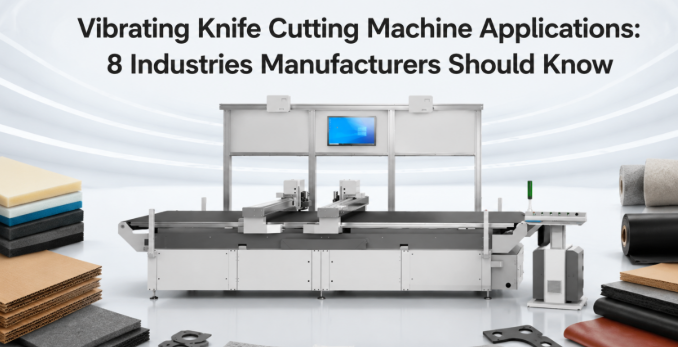
Sofa covers, cushions and curtain fabrics are cut by the meter. A wide-bed knife with automatic continuous feeding handles rolled textile without stopping, and double-head asynchronous control lets one side cut while the other nests the next job. This is where the ELS-B6616S CNC Flexible Leather Material Cutting Machine shines, with a 6000×1600mm work area built for large flexible sheets.
Application 5: Foam, Gasket and Rubber Sheets
Closed-cell foam, silicone gaskets and rubber up to roughly 50mm can be sliced without compression marking. Sealing gaskets, insulation pads and packaging inserts are typical runs. A knife leaves a crisp vertical wall that a laser would simply melt shut—critical when the part must seat and seal.
Application 6: Apparel and Garment Pattern Cutting
Fashion and uniform makers use vibrating knives for sample runs and small-batch production where laser scorching on synthetics is unacceptable. Pattern changes are instant: load the revised file, realign by projector, and cut. This removes the wait and cost of physical dies for every size and style.
Application 7: Packaging, Cardboard and Signage
Corrugated inserts, display stands and adhesive-backed signage vinyl are cut to shape for short-run and prototype orders. For advertising and exhibition teams, a knife produces clean display components without the burn edges a laser leaves on coated stocks.
Application 8: Composites, EVA and Luggage Panels
Luggage shells, EVA cases and bonded composite sheets used in electronics padding are cut and scored in one pass. The Channel Type Intelligent Cutting Machine ELS-B13S adds 20-megapixel vision positioning, so operators place material freely and the camera matches the pattern to the real sheet—ideal for luggage and digital-printing workflows with irregular layups.
Vibrating Knife vs Laser vs Die-Cutting
Choosing a method comes down to material, edge requirement and order mix. The table below summarizes where each fits on a flexible-material line.
| Method | Best materials | Edge quality | Tooling cost | Best for |
|---|---|---|---|---|
| Vibrating knife | Leather, foam, fabric, gasket, EVA | Clean, no heat mark | None (file-based) | Variable, small-batch, multi-material |
| Laser | Thin fabric, acrylic, some leather | Sealed edge, may scorch | Low | High-speed thin materials |
| Die-cutting | High-volume identical parts | Consistent, press marks | High per die | Stable, large runs |
Application Fit Self-Check for Your Factory
Tick the rows that match your production. Three or more checks signals a strong fit for a vibrating knife line.
| Your situation | Why it fits | Match |
|---|---|---|
| You cut leather, foam or fabric | Core flexible-material strengths | ☐ |
| Orders change frequently by design | No dies to reorder, just new files | ☐ |
| You lose material to poor nesting | Auto-nesting lifts yield 5–10% | ☐ |
| Heat/fumes are a problem area | Cold blade, no smoke or scorch | ☐ |
| Skilled cutters are hard to keep | 1–2 hour operator onboarding | ☐ |
See Your Materials Cut on a Hanhai Machine
Send us your samples and we will run free test cuts and return a 48-hour, no-obligation quote matched to your production line.
FAQs
What is a vibrating knife cutting machine used for?
It is used to cut flexible and semi-rigid sheets—leather, foam, fabric, rubber, gaskets, cardboard, EVA and composites—by rapidly oscillating a blade instead of burning with a laser. Factories use it for leather goods, footwear, automotive trim, upholstery, apparel, packaging and luggage panels.
Which materials can a vibrating knife cutting machine cut?
Natural and synthetic leather, woven and knitted fabric, closed-cell and soft foam up to roughly 50mm, rubber and silicone gaskets, corrugated cardboard, adhesive vinyl, EVA and bonded composites. Materials that melt cleanly under a laser often cut better on a knife.
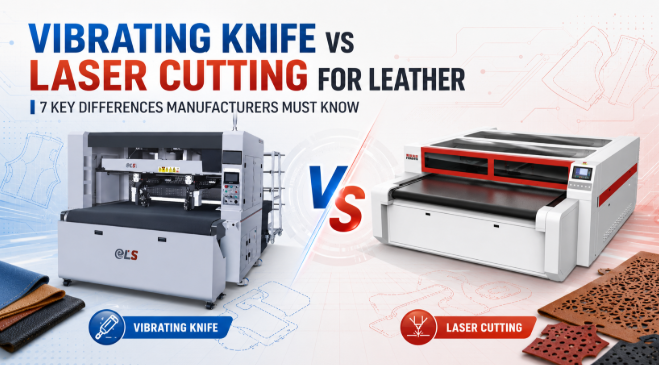
Vibrating knife vs laser cutting: which is better for leather?
For leather, a vibrating knife is usually better. It leaves a clean cold edge with no scorch or hardened burn line, and it needs no fixed dies, so pattern changes are instant. A laser can seal thin edges fast but may discolor premium hides and cannot handle thick foam-backed leather well.
How accurate is a vibrating knife cutting machine?
Cutting accuracy reaches ±0.1mm on models such as the ELS-3016S, with repeat positioning around ±0.2mm on sample-cutting units. That precision is enough for shoe uppers, gaskets and tight-tolerance trim.
How much does a vibrating knife cutting machine cost?
Price depends on bed size, vision systems and punch heads. Most factories see a 12–24 month payback once manual clicking, die storage and scrap from poor nesting are removed. Request a configured quote rather than a list price, since options vary widely.
Is a vibrating knife cutting machine hard to operate?
No. A 7-inch touch screen with a simple menu lets new operators master basic functions in 1–2 hours of training. Auto edge-finding, one-click pattern drawing and DXF/PLT import remove most manual skill from the job.
How do you maintain a vibrating knife cutting machine?
Maintenance is light: replace blades on a schedule tied to material abrasiveness, keep the vacuum table and linear guides clean, and check belt tension periodically. There are no dies to resharpen and no laser optics to align, which lowers upkeep versus the alternatives.
How long does it take to cut a leather shoe upper?
With a 1200mm/s maximum cutting speed on the ELS-3016S and auto-nesting, a full upper with perforations and punching runs in well under a minute per piece at production pace. Actual time depends on piece count and material thickness.
Can a vibrating knife cutting machine cut foam and gaskets?
Yes. Foam up to about 50mm and rubber or silicone gaskets cut cleanly with a vertical wall and no compression marking. This is why sealing gaskets and insulation pads are common knife-cut jobs that a laser would fuse shut.
What file formats does a vibrating knife cutting machine support?
Standard vector and layout formats include DXF and PLT, with many models also accepting AI, EPS, PDF, HPGL and JPG for reference. Files transfer over LAN, WLAN or USB, so integration with existing CAD and nesting software is straightforward.
Conclusion
A vibrating knife cutting machine is not a niche tool—it is the flexible-material workhorse behind leather goods, footwear, automotive trim, upholstery, foam and gaskets, apparel, packaging and luggage production. Wherever you need clean, cold-cut edges, instant design changes and higher material yield without dies, it pays for itself fast. If you want to see the edge quality on your own materials, contact Hanhai Tech for free test cuts and a configured quote.
Related Resources
- The Complete Guide to Oscillating Knife Cutting Machines — definitions, specs and buyer fundamentals
- Vibrating Knife Cutting Machine category — full model range from the factory
- CNC Leather Cutting Machine category — leather-specific configurations
- Channel Type Intelligent Cutting Machine ELS-B13S — vision-positioned cutting for luggage and printing
Recommended Products
- ELS-3016S Vibrating Knife Genuine Leather Cutting Machine — full hide digitization, defect ID and ±0.1mm cutting at 1200mm/s
- ELS-B6616S CNC Flexible Leather Material Cutting Machine — 6000×1600mm bed with auto-nesting for large flexible sheets
- ELS-B13S Channel Type Intelligent Cutting Machine — 20MP vision positioning for free-placed materials
- Intelligent Sample Cutting Machine ELS-B2S — double-head punch with 4 punches for sample and small-batch runs