Skip to content
Introduction
Buying a vibrating knife cutting machine is a capital decision, and the supplier you pick matters as much as the spec sheet. A strong manufacturer keeps your line running for years; a weak one disappears after the invoice clears. Purchasing managers and factory owners should evaluate suppliers on capability, not just price.
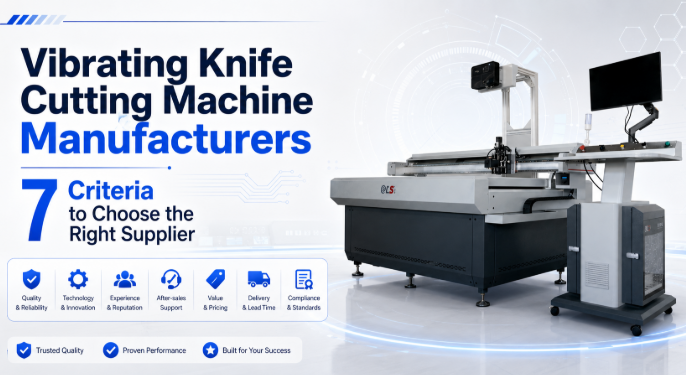
This guide gives purchasing teams 7 concrete criteria to grade any vibrating knife cutting machine supplier, plus a red-flag / green-flag table you can use as a scoring sheet during supplier audits.
Confirm It Is a Real Factory, Not a Trading Reseller
The single biggest risk is buying from a reseller who relabels someone else’s machine and cannot support it. Ask for the factory address, a live video walkthrough of the production line, and the machinery import/export license. A genuine manufacturer will show you welding, assembly, and a test-cut area without hesitation. Hanhai has built flexible-material automation equipment in-house since 2010.
Match the Machine to Your Materials
A supplier worth your time asks what you cut before quoting. Genuine leather, PU, foam, fabric, EVA, and rubber each need different blades and depths. For leather-heavy lines, a dedicated CNC leather cutting machine with defect-skip nesting beats a generic bed. If a supplier pushes one model for every material, that is a warning sign.
Check Build Quality and Cutting Precision
Precision separates production-grade machines from hobby kits. Look for a fully welded steel frame, ball-screw drive, and servo control. Hanhai cutters hold ±0.1mm cutting accuracy with 0.01mm repeat positioning — the kind of rigidity you get from a thickened all-steel frame like the HH-6090‘s construction philosophy. Ask for a repeatability test report, not just a brochure number.
Evaluate the Software and Nesting Yield
The software is where real savings hide. A good supplier provides auto-nesting that lifts hide utilization by 5–10%, imports DXF/PLT files, and detects leather defects so the cutter routes around scars automatically. The ELS-3016S builds defect identification and intelligent layout into the cut cycle; the ELS-B6616S extends it to 6000 × 1600 mm rolls. If the supplier cannot show the nesting yield math, keep looking.
Assess Training, Support, and Spare Parts
A machine is only as good as the people running it. Confirm the supplier trains your operators (Hanhai machines use a 7-inch touchscreen; a new operator is productive in 1–2 hours), stocks blades and consumables locally or ships them fast, and offers remote diagnostics. Ask who answers the phone at 2 a.m. in your time zone before you sign.
Review References and Factory Audits
Request two or three references in your industry — footwear, luggage, automotive interior, furniture, or apparel. A credible supplier will connect you or show case studies. The smart-factory cases from 2026 show how sensor feedback and predictive maintenance cut downtime. If a supplier has no references, that is a red flag.
Compare Total Cost, Delivery, and Warranty
Finally, score the commercial terms: delivered price, lead time, installation, warranty length, and payback. Most factories recover a well-chosen cutter in 12–24 months through labor and material savings. A supplier who hides spare-part pricing or won’t put warranty terms in writing is one to avoid.
Red Flags vs Green Flags When Evaluating Suppliers
| Criterion | 🚩 Red Flag | ✅ Green Flag |
|---|---|---|
| Factory proof | Won’t show production line | Live walkthrough + export license |
| Material fit | One model for everything | Asks your material first |
| Precision | Brochure number only | Repeatability test report |
| Software | No nesting yield data | DXF/PLT + defect-skip, +5–10% |
| Support | No local spares, no training | Training + fast consumables |
| References | None available | Industry case studies |
| Terms | Vague warranty, hidden parts | Written warranty + spare prices |
Shortlisting vibrating knife cutting machine manufacturers?
Send us your material and volume, and we will recommend a model, run free test cuts on your samples, and return a written quote with lead time and warranty — no obligation.
FAQs
What should I look for in a vibrating knife cutting machine manufacturer?
Look for a real factory (not a reseller), material-specific expertise, proven precision (±0.1mm cut, 0.01mm repeat), strong nesting software with defect-skip, operator training, spare-part availability, references in your industry, and a written warranty. Use the 7 criteria in this article as a scorecard.
How do I know if a supplier is a real factory or a trader?
Ask for the factory address and a live video tour of welding, assembly, and test-cut areas, plus the machinery import/export license. A genuine manufacturer shows production openly; a reseller deflects or only sends catalog photos.
Is it better to buy from a China manufacturer or a local distributor?
A direct factory usually offers better price and customization, while a local distributor can mean faster spares and on-site service. Weigh lead time and support against cost — and confirm the manufacturer provides remote diagnostics and ships consumables quickly either way.
How accurate are manufacturer-spec’d cutting machines?
Production-grade Hanhai cutters hold ±0.1mm cutting accuracy with 0.01mm repeat positioning on a welded steel frame. Always request a repeatability test report rather than trusting a brochure number when comparing suppliers.
What warranty should a vibrating knife cutting machine supplier provide?
Expect at least 12 months on the machine with clearly listed covered parts, plus accessible spare blades and service. Avoid any supplier who will not put warranty scope and spare-part pricing in writing before purchase.
How long does delivery and installation take?
Lead time varies with bed size and vision options, typically a few weeks for standard models. Ask for a firm delivered date including installation and training, and confirm who performs on-site setup.
Do manufacturers provide operator training?
Reputable suppliers do. Hanhai machines use a 7-inch touchscreen and a new operator is typically productive in 1–2 hours with training. Confirm training is included in the quote, not billed separately after delivery.
How much does a vibrating knife cutting machine cost from a manufacturer?
Price depends on bed size, vision system, and tool heads far more than the cutting technology. Most factories recover the machine in 12–24 months via labor and yield savings. Request a delivered quote with spare-part prices to compare suppliers fairly.
What spare parts should I stock?
Keep a stock of blades for each material, plus common wear items like guides and vacuum-table consumables. A supplier with fast, priced spare-part shipping is worth more than a slightly lower sticker price.
Can a supplier cut my samples before I buy?
Yes — any confident manufacturer will run free test cuts on your actual materials and return the results. Hanhai offers this before purchase so you can verify edge quality and nesting yield on your own leather or fabric.
Conclusion
Choosing the right vibrating knife cutting machine manufacturer comes down to trust built on proof: a real factory, material fit, verified precision, smart software, solid support, references, and clean commercial terms. Score each supplier against the 7 criteria and the red-flag / green-flag table above.
Ready to compare? Contact Hanhai Tech for free test cuts on your materials and a written quote with lead time and warranty.
Related Resources
- The Complete Guide to Oscillating Knife Cutting Machines — cutting cycle, blade types, and build details to grill suppliers about.
- How Hanhai Powers the Smart Factories of 2026 — real factory automation and support cases.
- CNC Leather Cutting Machine category — leather-specific models and nesting.
- Vibrating Knife Cutting Machine category — full range across materials.
Recommended Products
- ELS-3016S Vibrating Knife Genuine Leather Cutting Machine — leather digitizing with defect identification and smart nesting.
- ELS-B6616S CNC Flexible Leather Material Cutting Machine — automatic nesting for 6000 × 1600 mm rolls.
- ELS-B13S Channel-Type Intelligent Cutting Machine — 20-megapixel vision positioning for high-mix leather.
- ELS-B2S Intelligent Sample Cutting Machine — dual-head sampling with 4 punch heads for prototyping.