Skip to content
Introduction
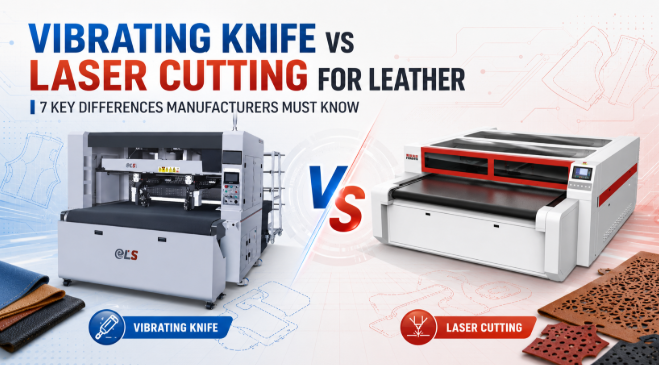
Leather factories face the same fork in the road almost every time they upgrade a cutting line: should the next machine be a vibrating knife cutting machine or a laser cutter? Both automate a job that used to mean dies, clicker presses, and skilled hand labor — but they cut in completely different ways, and those differences ripple into edge quality, yield, labor, and even whether your shop passes a safety audit.
This guide breaks the comparison down into the 7 differences that actually move the needle for purchasing managers and production teams. We keep it practical: real specs from CNC leather cutting machines, no jargon for its own sake. By the end you should be able to shortlist the right technology for your leather, your volumes, and your floor.
Cutting Principle: Mechanical Slice vs Thermal Vaporization
This is the root difference and it explains almost everything else. A vibrating knife uses a blade that oscillates up and down at thousands of strokes per minute (typically 10,000–20,000+ rpm), physically separating fibers. A laser uses a concentrated CO₂ beam that heats the material past its vaporization point and blows the residue away with assist gas.
Because one is cold and mechanical and the other is hot and optical, the two machines handle the same hide in fundamentally opposite ways — which is why edge quality and safety diverge so sharply downstream.
Edge Quality: Clean Cut vs Sealed But Scorched
On genuine leather, a vibrating knife leaves a natural, fray-free cut with no discoloration. A laser seals the edge (useful on synthetics and PU) but can leave a dark, slightly burnt line on real leather and a faint odor. For premium footwear and automotive interior where the cut edge is visible, factories overwhelmingly prefer the knife.
| Factor | Vibrating Knife | Laser Cutting |
|---|---|---|
| Genuine leather edge | Clean, natural, no burn | Sealed but can scorch / darken |
| PU / synthetic edge | May show slight fray | Melted seal, no fray |
| Odor after cut | None | Possible burnt smell |
Material Compatibility: What Each One Can and Can’t Cut
A vibrating knife is a generalist on soft, flexible materials: genuine leather, PU, fabric, foam (up to ~50mm), EVA, rubber, cardboard, and gasket stock. Swap the tool head and it also creases, scores, and punches. A laser is excellent on synthetics, thin fabrics, acrylic, and wood, but pure leather cutting machine work on real hides is where it struggles most.
- Vibrating knife wins: full-grain leather, multi-layer soft composites, thick foam, materials that scorch or outgas under heat.
- Laser wins: sealed synthetic edges, engraved logos, thin technical textiles, and parts needing a fused hem.
- Both handle: PU, PVC-backed materials, and most bag and upholstery substrates.
Precision and Tolerance
Both technologies are precise. Hanhai knife cutters hold a cutting tolerance of ±0.1mm with a repeat positioning accuracy of 0.01mm on a fully welded steel frame (see the HH-6090 engraving machine frame philosophy). Lasers are similarly tight on thin materials but can drift slightly on thick, uneven hides where the beam focus shifts across the nap.
Speed and Throughput
For complex, nested leather patterns, a knife with automatic nesting software often beats a laser because it cuts more parts per hide — and smart nesting lifts leather utilization by 5–10%. A laser can be faster on simple, repeated outlines in synthetics. Throughput therefore depends less on raw head speed and more on how well the machine nests your specific shapes.
Operating Cost and Maintenance
A vibrating knife’s main consumable is the blade, which is cheap and tool-free to swap. A laser’s CO₂ tube is the expensive wear item and degrades over time, plus optics need cleaning in a dusty leather environment. Energy use is comparable, but laser optics and tube replacement push lifetime cost higher for high-hour shops.
Workplace Safety and Compliance
Lasers generate fumes and, on some coated leathers, potentially hazardous vapor that demands extraction and sometimes filtration. A knife produces fine dust (easily captured by the machine’s vacuum table) but no fumes and no beam-safety enclosure requirement. For factories in tight urban workshops or with strict air-quality rules, the knife is the lower-friction choice.
| Difference | Vibrating Knife Cutting | Laser Cutting |
|---|---|---|
| 1. Principle | Mechanical oscillating blade | Thermal CO₂ beam vaporization |
| 2. Edge | Clean, cool, natural | Sealed, possible scorch |
| 3. Materials | Leather, foam, fabric, EVA | Synthetics, thin textiles, wood |
| 4. Precision | ±0.1mm, 0.01mm repeat | High on thin; varies on thick |
| 5. Speed | Faster with nesting (+5–10% yield) | Fast on simple synthetic outlines |
| 6. Cost | Blade consumable, low upkeep | Tube + optics are costly |
| 7. Safety | Dust only, no fumes | Fumes need extraction |
Not sure which cutter fits your leather line?
Send us your material samples and we will run free test cuts on both a vibrating knife and a laser, then send you the edge-quality comparison and a no-obligation quote within 48 hours.
FAQs
What is a vibrating knife cutting machine used for?
It is used to cut flexible materials — genuine leather, PU, fabric, foam, EVA, rubber, and cardboard — by mechanically oscillating a blade. On a CNC leather cutting machine it replaces dies and hand cutting for footwear, bags, upholstery, and automotive interiors.
Which is better for leather, vibrating knife or laser?
For genuine leather, the vibrating knife is better: it gives a clean, cool, burn-free edge and higher hide utilization through nesting. A laser is better only when you specifically need a sealed synthetic edge or engraved marking on coated materials.
How accurate is a vibrating knife cutter on leather?
Hanhai knife cutters hold a cutting tolerance of ±0.1mm with 0.01mm repeat positioning accuracy, which is more than enough for stitch-line and component accuracy in leather goods.
Does laser cutting burn leather edges?
It can. The CO₂ beam seals the edge but often leaves a darkened, slightly scorched line and a faint odor on real leather. That is why premium leather factories prefer a mechanical knife cut.
Can a vibrating knife cut thick leather and foam?
Yes. With the right blade and depth setting it cuts thick full-grain hides and foam up to roughly 50mm. The ELS-B6616S is built for automatic nesting of flexible leather and foam materials.
Is a laser cutting machine hard to operate?
Both are operator-friendly. Hanhai machines use a 7-inch touchscreen and a new operator is typically productive in 1–2 hours. Lasers add optics cleaning and fume-extraction checks to the routine.
How much does a leather cutting machine cost?
Price depends on bed size, vision system, and tool heads. Request a tailored quote for your volumes — typical factory payback runs 12–24 months through labor and material savings. See our vibrating knife range for model options.
Do I need exhaust for a laser leather cutter?
Yes. Laser cutting releases fumes and, on some coated leathers, potentially hazardous vapor, so you need extraction and often filtration. A vibrating knife only produces fine dust captured by its vacuum table.
Can one machine do both knife and laser?
Some hybrid beds exist, but most factories run a dedicated knife for leather and a dedicated laser for synthetics/engraving. A channel-type cutter like the ELS-B13S with vision positioning covers high-mix leather work very efficiently on its own.
How long does it take to set up a cutting file?
Designs import as DXF or PLT, and the nesting software auto-arranges parts on the hide. A new pattern is usually cutting-ready in minutes, with defect-avoidance nesting handled automatically on models such as the ELS-3016S.
Conclusion
The 7 key differences — principle, edge, materials, precision, speed, cost, and safety — all point the same way for real leather: a vibrating knife cutting machine gives the cleaner edge, higher yield, and simpler floor. A laser earns its place when sealed synthetic edges or engraved marks are part of the product. Match the tool to the material, not the other way around.
Still deciding? Contact Hanhai and we will cut your actual samples on both technologies and send the comparison plus a quote — no obligation.
Related Resources
- The Complete Guide to Oscillating Knife Cutting Machines — deeper dive into knife technology and tool heads.
- Laser Cutting Machine category — see where CO₂ cutting fits your line.
- CNC Leather Cutting Machine category — the dedicated leather range.
- How Hanhai Powers the Smart Factories of 2026 — real factory automation cases.
Recommended Products
- ELS-3016S Vibrating Knife Genuine Leather Cutting Machine — leather digitizing with defect recognition and smart nesting.
- ELS-B6616S CNC Flexible Leather Material Cutting Machine — fully automatic nesting for leather and foam.
- ELS-B13S Channel-Type Intelligent Cutting Machine — 20-megapixel vision positioning for high-mix leather.
- ELS-B2S Intelligent Sample Cutting Machine — dual-head sampling with 4 punch heads for prototyping.