Skip to content

Introduction
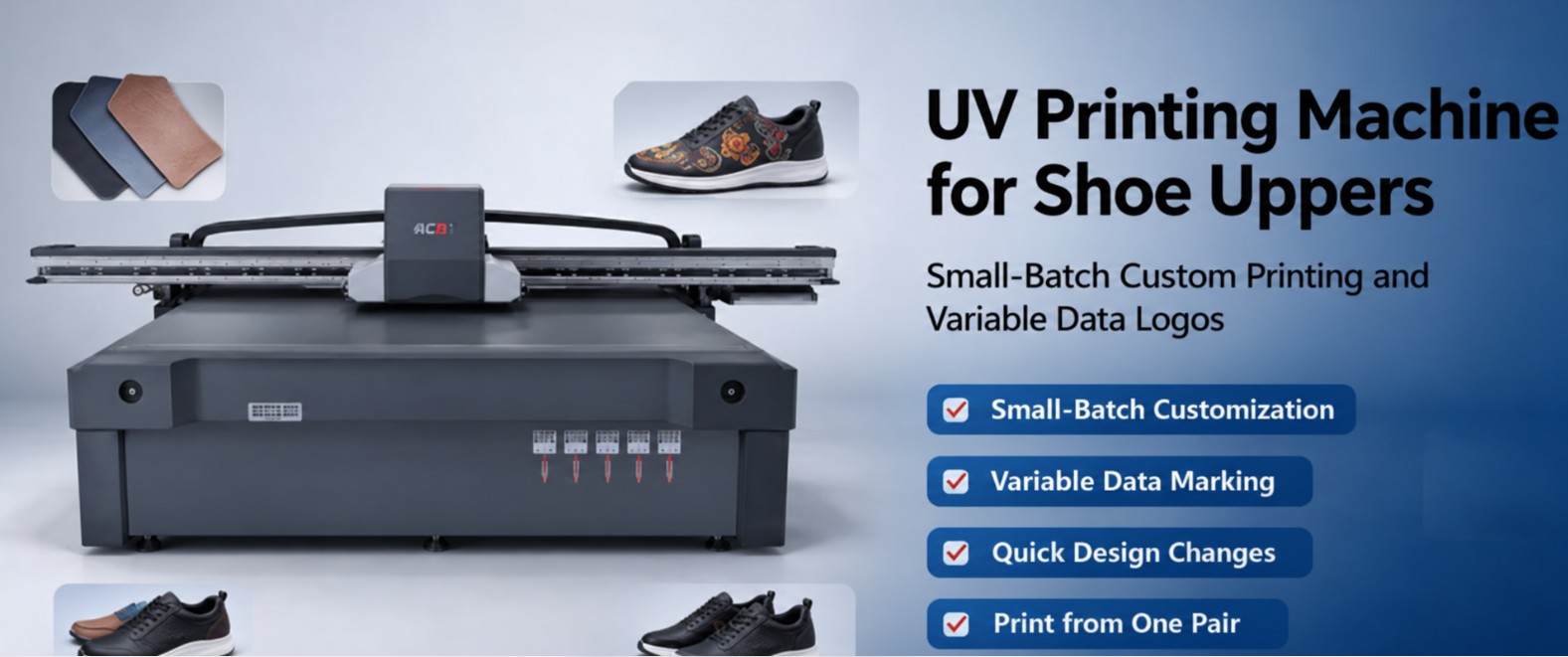
Walk into any sneaker store, and you’ll see: same shape, same color, but the logo on the side changes depending on the size. One pair might have faded animal print, another might feature a metallic swoosh, and limited-edition tongues even come with a serial number. This isn’t hand-painted. These are all printed with UV printers specially designed for sneakers, quietly changing how brands view small-batch production.
Screen printing was never meant for this design. Each color needs its own screen, and even the smallest print run costs money, plus you need a few days to set up between designs. UV printing is totally different: you just upload the file, the machine prints it, and the ink cures under UV light as soon as it touches the material. No screens, no drying racks, and no unavoidable minimum order.
This guide explains the role of UV printers in the shoe upper production line, why brands are starting to use them, which materials easily absorb ink, and when it’s best to use this technology.
What UV Printing Does for Shoe Upper Production

High-precision color reproduction with one-time UV curing
Shoe decoration has always been a compromise: screen printing (cheap for single pieces, but slow to change designs), roller printing (logos look great, but gradients don’t work well), embroidery (premium and heavy, not suitable for mesh materials). UV printing skips all three of these problems.
A UV printer sprays UV-curable ink directly onto the shoe upper. The ink droplets are so tiny, like skin cells, that the gradients are super smooth, and the image looks as realistic as a photo—something hard to achieve with screen printing without multiple layers of screens. The color accuracy comes from the whole process: first, the material colors are calibrated, then the file is sent to the RIP software, which turns it into a dot pattern exactly like the original sample.
‘One-time curing’ is just as important as resolution. When the print head moves, the UV LED hits the wet ink in a few milliseconds, causing it to polymerize. No wet stage, no mess, and no need to wait for drying. Workers can take the printed uppers straight from the printer and hand them over to the sewing team right away. In a factory running two shifts, this completely eliminates drying racks and the potential bottlenecks they could cause.
After curing, the UV ink will also form a thin and flexible layer on the surface. It’s wear-resistant, won’t wash off, and won’t peel even when you bend while walking.
Why Brands and Factories Adopt It Now

Supports small-batch, multi-variety custom production
The main reason is the change in ordering patterns. Ten years ago, a brand might order 30,000 pairs of the same color shoes at once, without even worrying about how they would sell. Now, they order 500 pairs first, watch the sales for two weeks, and then decide. This completely messes up the economics of screen printing—making a screen just for 500 pairs of shoes just isn’t worth it.
UV printers don’t care about any of that. The setup time between different designs is just the time it takes to load a new file. You can print 20 pairs of the same shoes first, and then switch to printing 10 pairs with a custom logo — all of that can be done in one go.
Shortens the sample development cycle
In the past, making a sample used to take seven to ten days: designing, making the screen, test printing the sample, sending the sample, making revisions, and then repeating the whole process. With variable data printers, this can be cut down to just a few hours. Designers can send a file at 9 a.m., have it printed on the actual material by 10 p.m., and ship out the sample that same afternoon. No need to wait for a screen, and color adjustments just require changing the file.
Makes the supply chain more flexible for fast-changing styles
Street fashion trends are changing as fast as the internet. A viral video can sell out a design within 48 hours; factories that can respond within 48 hours are the winners. UV printing technology allows factories to keep fewer blank shoes in stock, decorate them on demand, reduce unsold inventory, and simplify storage.
Materials and Processes

Leather, synthetic leather, mesh fabric, EVA composite
Most upper materials can be used pretty well, as long as they’re relatively smooth and a bit flexible. Genuine leather is especially great for UV ink printing because the ink just sits on the surface, making the print really sharp. Synthetic leather (PU/PVC) is even easier to print on since the material is more uniform. Mesh can be a bit tricky—the ink might seep into the fabric—but with the right setup and prep, you can still get awesome results. EVA composite materials are also an option, though you might need to prime them first to make sure the ink sticks. Super stretchy materials need extra attention, so good machines use a vacuum worktable to keep the material flat.
Integrates with upper cutting and lining bonding steps
A custom leather UV printer sits between cutting and stitching. The cutting machine handles creating the top layer of the leather, then the printer decorates the leather while it’s lying flat, after which the top layer goes to stitching. Printing on a flat surface makes alignment easier and avoids issues with seams and curved areas. Factories usually apply the lining right after printing because the cured ink doesn’t affect the glue’s adhesion.
Variable data printing: custom logos, pattern elements, one-piece consistency
Most underrated feature: the printer can change what it prints on each product without slowing down. The first batch prints serial number 0001, the second batch prints 0002. Limited edition customer names, athlete numbers, logos for specific regions—all of this is pulled from a spreadsheet and automatically placed.
Overall consistency means that the color and positioning of the top and bottom parts should match. Screen printing might have shifts due to template wear, but UV printing won’t, because the pattern is controlled by the RIP file and servo-driven rails.
Typical Applications

Sports shoes and casual shoes
Performance shoes are the best choice — running shoes, basketball shoes, and training shoes all feature logos and color-block designs that used to require screen printing. UV technology lets brands release special athlete editions in small batches, launch colorways for specific cities, and use reflective ink.
Special-shaped upper materials
The upper is the part of the shoe that has curves, clear contours, and stitching. Flatbed UV printers can handle this because the operator places each part into a fixed fixture, and the camera system aligns the design to it, whether it’s on a curved toe or a folded tongue.
Advertising, gifts and garment decoration
This technology is now used for more than just shoeboxes: promo packs, gifts, small-batch branded clothing. Factories usually take on some side jobs to keep the machines running between shoe orders.
Table 1. UV Printing vs Screen Printing for Shoe Uppers
| Aspect | UV Printing | Screen Printing |
| Setup time | Load a digital file, seconds | Burn screens per color, days |
| Color capability | Photorealistic, gradients, variable data | Limited by number of screens |
| Recommended batch | From 1 pair to ~1,000 pairs | Above ~5,000 pairs |
| Curing / drying | Instant UV cure, no drying rack | Wet ink requires drying time |
| Best fit | Custom, small-batch, fast-changing styles | Long fixed-run colorways |
FAQs
Can UV ink flex with the upper without cracking?
It depends on the ink and material. Flexible UV ink can stretch with leather and synthetic leather without cracking. On very thin mesh or stretchy spandex, cracks may appear after repeated bending, so for these materials, softer ink or post-treatment is used. You can request a bend test before placing an order.
How is UV printing different from screen printing for uppers?
Screen printing works by pushing ink through a stencil—it’s cheap for large batches, but switching designs is slow and colors are limited. On the other hand, UV printing sprays ink from a digital file and cures it instantly, so you can change designs in seconds. Generally, screen printing is more cost-effective for over 5,000 pairs; if the quantity is small, or you need variable data or gradient effects, UV printing is better. Many factories use both methods.
What batch size is UV printing best suited for?
In general, UV printing is more appealing when the quantity for each design is under 1,000 pairs. For quantities between 1,000 and 5,000 pairs, its competitiveness depends on the variation in colors and styles. When it exceeds 5,000 pairs, it actually can’t compete with screen printing—but setup time and inventory risks might still give it a bit of an edge.
Conclusion
UV printers can’t replace all decoration techniques. They’re designed for small batches, variety, and quick turnaround—which traditional screen printing has always struggled with. If your orders lean toward small batches and variable data, a UV printer isn’t a luxury, it’s an essential piece of equipment.
Hanhai has developed a flat UV printing system for shoe uppers, equipped with a vacuum workbench, camera calibration, and a RIP workflow customized for leather, synthetic leather, and mesh. The right machine can pay for itself through sample printing speed and one-pass yield. Send a few pieces over, and we’ll print them back for you.