Skip to content

Introduction
A tiny hole might seem like just a small detail. But on a shoe, a row of ventilation holes can totally change how breathable it is. On a leather bag, perforation patterns can completely alter the overall look. On car seats, how precisely those holes are placed is what makes it look high-end versus cheap. The problem is, hand punching is slow and all over the place, which is why factories have been trying to automate it for decades.
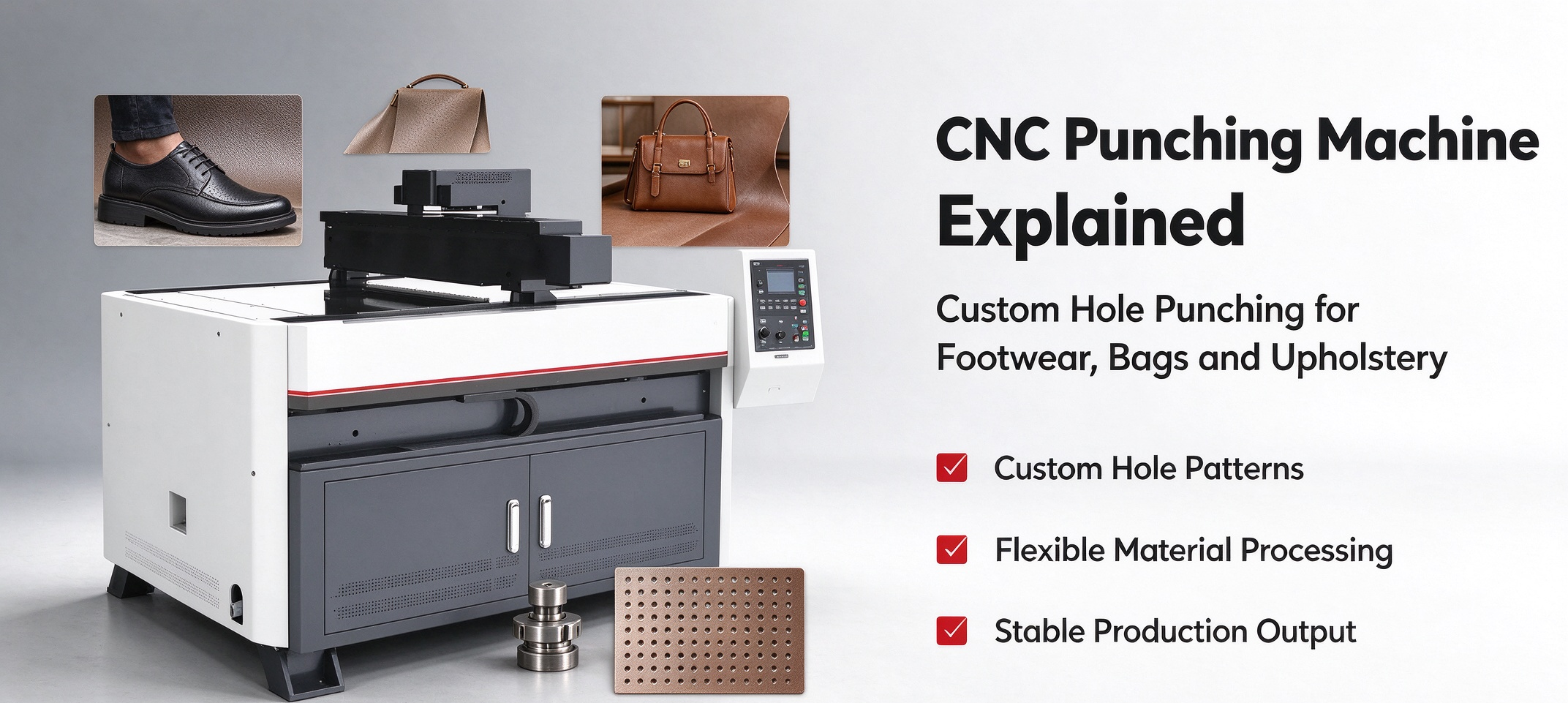
CNC punching machines are the modern solution. They press the punch down onto the material, use custom molds to stamp it, and then just repeat the whole thing based on a digital design. The size, spacing, and angle of every single hole stay exactly the same for every product and every shift. Operators don’t have to punch holes by hand anymore—the machine just does it for them.
What Is the CNC Punching Machine

High punching accuracy and stable operation
A CNC punch press is basically a stamping machine mounted on a programmable X-Y gantry. The gantry moves the material to each hole position, the punch comes down, the die punches a clean hole, and then the punch retracts. Every position is servo-controlled and locked in by coordinates, rather than relying on the operator’s judgment.
The precision can hit a few hundredths of a millimeter, so a 200-hole pattern stays perfectly aligned while it’s being fed through. For slightly elastic leather, the gantry keeps the sheet nice and flat and stops the surrounding areas from deforming while it punches. Stable operation means the first hole and the 10,000th hole are exactly the same—a guarantee you just can’t get with a manual punch because of wear and operator fatigue. But CNC punch presses don’t have that problem.
Strong compatibility across flexible materials
A well-designed automatic stamping machine can handle most flexible materials: leather, synthetic leather, vinyl, fabrics, felt, neoprene, EVA foam, and thin composites. The punch has to match the thickness and hardness of the material—thicker leather needs a heavier punch and more pressure, while thinner fabrics use a sharper punch and lower tonnage. Good compatibility also means you only need to swap out the punch when you switch materials, without having to readjust the machine.
What It Is Used For

Footwear uppers, leather bags, luggage and leather goods
Shoes are a classic example: the ventilation holes at the toe, the lace holes, and decorative perforations that match the design style. CNC stamping machines punch holes based on programmed patterns, so every pair of shoes ends up with identical hole placement—which is super important when breathability is a selling point. Bags often have perforated panels and metal eyelets; suitcases get punched for reinforcement and ventilation; and belts, watch straps, and keychains almost always get punched on these machines.
Automotive interior parts, sofa upholstery, garment decorations and fashion headwear
Car interiors are a huge market for custom perforation. Car seats use perforated leather for ventilation and looks, and CNC punching machines can bang out thousands of holes at perfectly even spacing—which is a big deal because once the seats are assembled, any misaligned holes really stand out. Sofa cushions and recliner panels also use decorative perforations and metal holes; and clothing and hats with ventilation holes are part of this market too.
Home textiles, sports protective gear, plush toys, craft gifts and advertising labels
The list goes on and on: ventilation holes on pillowcases and curtains, vent holes on helmet pads and gloves; facial features and vent holes on plush toys; custom designs on leather patches and book covers; mounting holes on tags. The press on that multifunctional shop floor is hardly ever sitting idle.
Customization Strength

Various custom hole shapes and sizes
The reason factories buy CNC punching machines instead of fixed-die punch presses is all about customization. Fixed dies can only punch one shape, while CNC machines let you swap out dies to punch round holes, square holes, slots, buttonholes, stars, and basically any custom design the designer dreams up. The die itself is physical, but the positions and patterns are digital—the designer can draw the pattern on a tablet, send over the DXF file, and have the punching done that same afternoon, without waiting around for die design or tool making.
Consistent hole pattern across large sheets
Keeping things consistent across big pieces of material is exactly where CNC machines wipe the floor with manual work. A car seat cover might have three or four hundred holes; by the fifth row, a person might start screwing up, but a CNC punch just keeps going precisely according to the coordinates. This is a huge deal for assembly: if the holes in the seat cover foam are punched evenly, everything lines up perfectly; but if the pattern is off, it just looks totally weird.
Why It Matters for Production

Stabilizes finished-product quality
Holes punched by hand depend entirely on how skilled the operator is feeling that day. But if you punch them with a CNC machine, it all comes down to the file—every single hole comes out exactly the same. A brand-new operator can produce the same results as a veteran because the machine handles all the precise work. For suppliers who have to pass audits, predictable hole positions, dimensions, and edge quality make the audit results predictable too, which really helps you win those repeat orders.
Greatly boosts punching efficiency vs manual work
The difference here is huge. If you’re punching by hand, it takes a few seconds just to make one hole; but a CNC machine can punch several holes per second, and moving between positions only takes a few milliseconds. For a panel with 200 holes, manual work takes five to ten minutes, while a CNC machine can knock it out in less than a minute without ever getting tired. Five manual workers might punch a few hundred panels in a shift; one CNC machine with a single operator loading the material can hit the exact same output.
Table 1. Manual Punching vs CNC Punching
| Aspect | Manual Punch | CNC Punch |
| Punching rate | About 1 hole every few seconds | Several holes per second |
| Time per 200-hole panel | 5-10 minutes | Under 1 minute |
| Consistency | Drifts by the fifth row | Coordinate-controlled, uniform |
| Labor per shift | 5+ operators for decent throughput | 1 operator loading material |
FAQs
How fast can it switch between hole shapes?
Changing molds only takes a few minutes—just throw on the punch, align it, and do a quick test. If you’re only making one shape a day, it’s no big deal; but if you’ve gotta switch it every hour, that time really adds up. Better machines come with quick-change fixtures or multi-tool turrets that can switch automatically under program control. So if you expect to be changing molds a lot, make sure you ask about the changeover time.
What materials besides leather can it punch?
Most materials can be cut with molds: artificial leather, fabric, canvas, felt, neoprene, EVA foam, rubber sheets, thin cardboard, and some composites. Super stretchy materials might pull away from the mold, but you can still handle them using a presser foot and sharp molds. Brittle stuff like thick acrylic isn’t suited for leather punch machines—you’d need a heavier press or an engraving machine to deal with that.
How does CNC punching compare to laser perforation?
They actually overlap a bit. Lasers “punch holes” by vaporizing the material, while CNC punch presses cut using molds. CNC makes clean through-holes but is limited by whatever molds you’ve got on hand; lasers can make any shape without any tooling, but thick leather burns easily and the edges get heat-affected. Factories working with thick leather tend to prefer CNC, while those dealing with thin materials or complex patterns lean toward lasers. A lot of factories just end up using both.
Conclusion
At first glance, a CNC punching machine might not look like much—until you compare it to the manual processes it replaces. The holes come out cleaner, the patterns are way more consistent, and the productivity boost you get from each operator is enough to surprise anyone who hasn’t seen it in action. For shoes, bags, car interiors, and soft furnishings, this isn’t some luxury—it’s the difference: the difference between steps that rely on skilled workers and steps you can just do by following a file.
Hanhai Manufacturing offers a complete automatic punching system, equipped with a programmable gantry, quick-change die base, and vacuum workbench, suitable for shoes, leather goods, and car panels. If you’re still punching by hand, you can send us a few samples, and we’ll punch them with the machine for you so you can compare the edge quality and hole consistency yourself.